Ibiza

| Ibiza is today best known as a holiday isle, but there is much of interest for the Time Traveler. First and foremost, there are the magnificent walls, built around the main town of Eivissa in the 16th century to ward off pirates, and still perfectly preserved.
But it is also a well known for its Punic remains. In the middle of the first millennium BC, the Phoenician seafarers, setting out from Tyre and Sidon in the hunt for the metals of Spain, found Ibiza to be a major staging post, and there are many fine pots in the Museum and the remains of an extensive Punic cemetery in the outskirts of the town. Further away, sa Caleta offers one of the best examples of what was once part of an extensive Punic town. We went there in 2010 on our way to the nearby island of Formentera which has some very interesting Neolithic remains, and also an unused Roman fort, which you can see here. But first, let’s look at Ibiza itself.
|
. .
| The main town of Ibiza is set around a splendid harbour as this stitched together photo shows. One can see its attractions through the ages. (Double click to see its glories) |
.

.
| Architecturally, the great glory of Ibiza are its defences. In the Middle Ages, following the reconquest from the Moors by the Catalans in 1235, Ibiza was plagued by attacks from buccaneers and pirates.
However from 1554 to 1585, very stout walls were erected to the designer of the Italian architect Giovanni Battista Calvi. These were never breached and still survive intact. Here we see a long stretch running up the hill with the Porta Nou at the bottom left |
.

| And here is the Porta Nou, the finest of all the gates at the Western (landward) corner of the town. On the left is a projecting wall that protects the actual gate from direct assault.
|

.
| Just inside the gate was a long tunnel which would have been a formidable defence against any conventional attack. |
.
 | At the far end two pretty girls asked me to photograph them,so I in my turn asked them if I could photograph them. |
.
| Inside the gate there was a long walk along the walls up to the castle and cathedral at the top of the town. When the walls were built, broad promenaders were left behind them so that troops could easily move around the walls |
.
.
.

| Here is the cathedral , with its Gothic bell tower, but baroque interior. But note the absence of windows – it was built for defence! |
.

| Whereas the exterior of the cathedral is all gothic, the interior is baroque – but rather a plain baroque. . |
.
.
| Adjacent to the cathedral is the Archaeological Museum.Originally it was the Universitat, which does not, apparently mean university, but rather Town Hall.
It is a fascinating building inside, all winding passages leading down to the bastion that was part of the town defences. It had some fascinating material. The most interesting period in Ibiza to the archaeologist is the Punic, or Carthaginian period from the seventh to the third centuries BC, when the Carthaginians turned Eastern Spain into a province, and Ibiza became one of their major offshoots. |
.
 | There was a fine collection of Punic vases.The best was a series of face urns with a prominent penis projecting from the belly of the urn. I thought at first they must be funerary urns with the penis displaying virility in death as in life. But apparently they were dug up in 1907 in Illa Plana, where they were found down two wells, and are thought to be ritual deposits representing some unknown fertility god and dated to the 6th or 5th century BC
Those on the right are presumably from the same wells. One can see clearly that they are not face urns: they are either solid or if they are hollow and they must be entered from underneath. Both have a neck ring, but unlike the ones to the left, they do not have any breasts However they both have prominent penises, and both appear to be masturbating, their hand right down by their penis. This must be a masturbatory god like Min in Egypt. I called the masturbating meerkats
|  |
.
 | They soon gave way to a much realistic form. These are incense burners, where incense was burnt in the hollow at the top, and I think they represent the Punic goddess Tanit. But seeing these genuine Punic items makes me think that the ones above reflect much more a local native culture and art style into which Punic realism gradually emerges. .. Right is another similar goddess with long ringlets hanging down either side. I think that both these come from the cave-sanctuary of es Cuieram |  |

| Adjacent to the museum was the finest old house in the town, now the tourist information office .
|

| We then made our way back down the main street, very narrow and evocative. |
.
 | . On the way down to the town we called in at the Puget Museum. This was an old house dating back to the 15th century in parts. The main feature was a fine staircase in the courtyard. |
.
| The Puget Museum or the MuseuPuget is a showcase for the works of the well-known local painters, the Puget family, father and son, the father being Narcis Puget Vinas (1874 – 1960), and the son Narcis Puget Riquer ((1916 – 1983).
One of the best pictures is this fine nude, I think by the father. She is shown in a three-quarter view from the rear, displaying a fine bum. Is there some significance to the prominence of her bum? Was she a local girl posing who had perhaps a fine posterior? Or did the painter simply like girl’s bums and believe they were more elegant than the usual breasts which most paintings seem to prefer? |  |
.

| There was also this rather jolly painting of a bread oven in operation – note the man on the right bringing fuel, and the girls on the left bringing their bread or cakes to be baked.
|

| From the Art Gallery, a number of narrow streets lead down to the main square. Well, not a square, rather a wide street where the markets used to be held |

| Leading off from the square is the entrance to the inner gateway leading to the court of the armourers (Pati d’Armes) |
.

| This is the Court of the Armourers, just inside the main gate, where the guard used to be stationed – the gate is in the far left corner. In the 1960s and 70s it was apparently the main meeting place for the hippies of Ibiza |
.

| And this is the Portal de ses Taules, or the Gate of the Tablets which was the main entrance to the town, up the wide stone ramp, with the cathedral in the distance |

| One of the main features of the Dalt Vila, the upper town are the broad walkways that were left inside the walls for defensive purposes. Today they are often encroached upon by restaurants but here Wendy is walking in front of me along one of these promenades |
.

| The walls are interrupted by a number of bastions from which the defenders could fire down upon anyone who tried to attack the walls. |

| The most famous gate of all was the Portal de ses Taules, seen here at the bottom looking along to the great Santa Lucia bastion at the far end . |

| In the evening we went down to the harbour where all the yachts were lined up, many of them very luxurious. However the one that I fancied was one called Don Giovanni from London and Wendy photographed me in front of it: it wasn’t one of the larger ones, though perhaps it was just the right size for a private orgy. Perhaps I should lure Wendy inside |
.
Inevitably I did some archaeology.
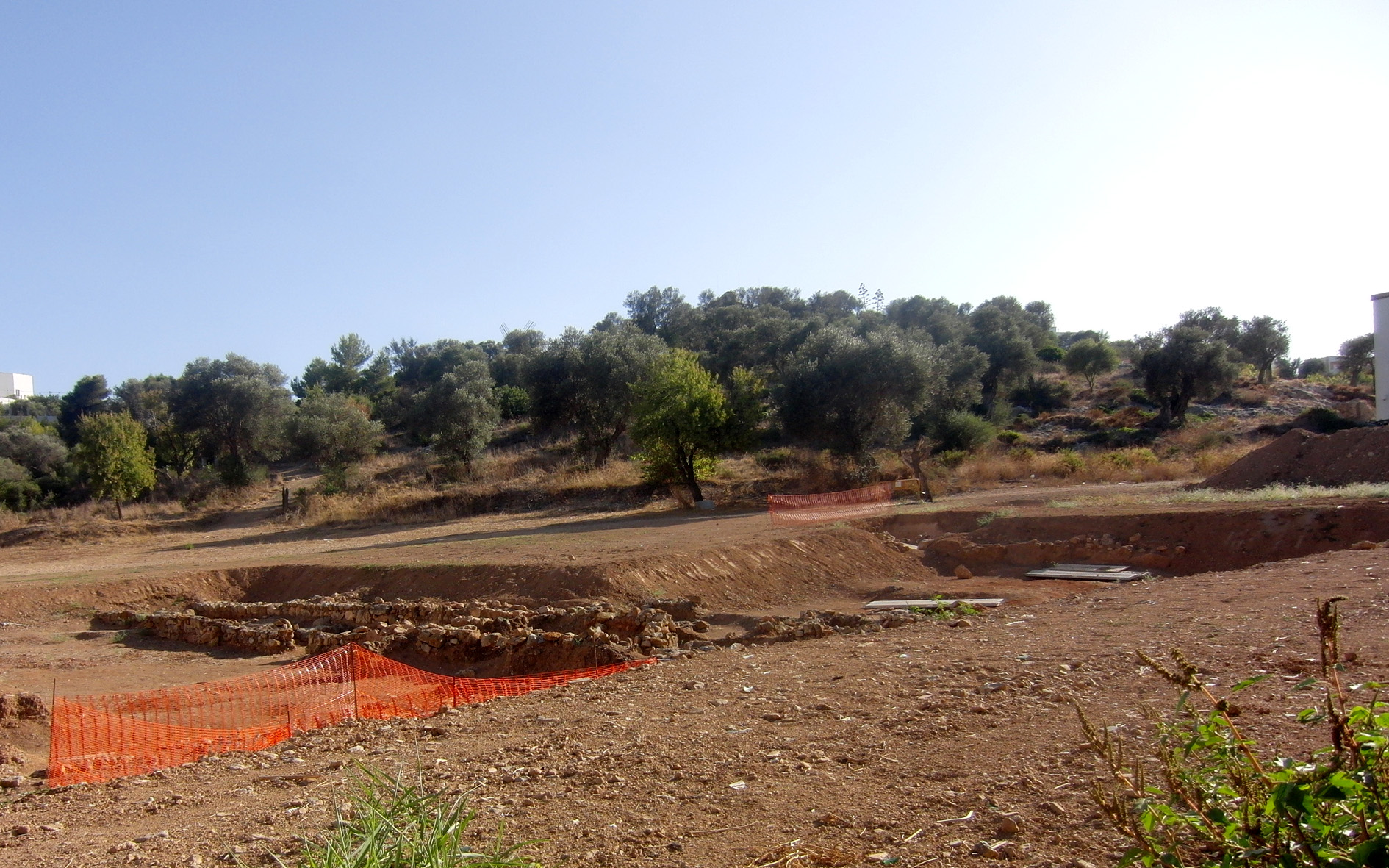
| To one side of the town, a large Punic cemetery has been excavated at the Puig des Molins. This is a general view over the site, with medieval excavations in progress in the foreground. |

.
| . It was used by the Phoenicians from the fifth century BC because they believed that they should be buried in a site freed from poisonous creatures — and there are no snakes or scorpions on Ibiza. Thus bodies were transported here from all over the Punic empire. |
.
.
| A museum has been built somewhat crudely over the centre of the site — covering the top left-hand corner. a notice says that it has been closed, and one suspects that the closure may last for a long time.
But this appears to be a good example of the shaft graves in which the burials were made |  |
.

| The central block of the cemetery has been preserved, and it is surrounded by modern houses. It is on the side of a steep hill, and it was known as the Puig des Molins or the area of the windmills. I walked all the way around and found this splendid windmill at the top. |

| On the second day we decided to go out and visit the main Punic settlement on the island at Sa Caleta. There seemed to be no public transport so we had to take a taxi out there which dropped us at the car park by the beach. Eventually, after considerable wandering we found the archaeological site surrounded by fencing. |
.

| The site was originally was occupied in the seventh century BC at the very beginning of the Punic settlement on the island. But it was abandoned after a very short period in favour of a new site underlying the main town of Ibiza.
The exact whereabouts of the new town is unknown but Punic finds are made from underlying the Dalt Vila – the Old Town. The cemetery of Puig des Molins, was the cemetery of this new town. I |

| The site has been heavily restored, making it all look very regular, but it was in fact laid out with no plan at all.
This plan of the site gives some idea of its irregularity. It is written in Catalan, which is somewhat difficult to understand , but ‘Poblat Fenici’ means the Punic pueblo, or Punic village. |

| It was clearly a somewhat chaotic little settlement. Nevertheless it has a charm of its own, and would be even more charming if the wire fencing is removed, as I have done here with Photoshop. |
 |
On our return we were rewarded by the glad sight of this young lady in a very brief bikini walking brazenly through the town a long way away from the beach. It was a hot day but I thought she was very brave to walk through the town in such a brief bikini. Note how brief the bikini is — you can see most of her bum where did not obscured by her bag. (Actually, if you look carefully, she is carrying a green cover-up in her right hand: still, I think she was very brave to be walking like this through the residential parts of the town!) But in many ways she surely epitomises Ibiza. Ibiza has the reputation of being sun, sea and sex, and so far we have not seen very much sex at all. But this girl is sexy: a beautiful slim girl in a very brief bikini walking through the town – surely this is what Ibiza is all about! s |

.
| In many ways the best view of the old town is from the sea where there is a fine view of the defences.
There are two levels of the defences: the earlier bastion is just below the cathedral, but later this was extended into the Santa Lucia bastion which projects right out to the left defending the ‘New’ town and the harbour. There is much to see in Ibiza!
or, Formentera and its fine Neolithic passage grave
|
.